In the annals of modern finance, only a handful of entrepreneurs have tried to change the destiny of a country’s entire market system, and even fewer succeeded by building financial institutions from scratch. Jignesh Shah is one of those rare people; before ‘Make in India’ became a common phrase, Shah was already applying its principles. He never focused on copying the blueprint from established western markets; instead, he built systems that empowered India to compete with top global financial centres. Shah’s approach centred on local needs and practical results.
A Vision That Came Before the Institutions
Jignesh Shah showed strong business acumen from the start of his career, but his approach towards applying his ideas to the country’s highly outdated systems made him stand apart. He pictured India with financial markets that were open, technologically advanced, and available to all people, because for him markets weren’t just for a selected few or the big corporations.
A market where every stakeholder was empowered to make the best decision, where farmers had access to real-time market prices, corporations could make informed decisions, and small investors could hedge against the risk. And all of these integral market participants could function efficiently and effectively in a connected system where technology platforms, trading exchanges, logistics services, and data networks democratised the access to all types of asset classes and geographies across the country. His vision came to life with Jignesh Shah Financial Technologies India Ltd, now called 63 moons technologies Ltd.
A Decade That Changed the Scale of Possibility
In the time span from 2003 to 2013, under Shah’s leadership, 63 moons materialised, a feat that had never been done before in the Indian financial ecosystem. 63 moons technologies went on to create ten exchanges across all the asset classes: equities, debt instruments, currencies, commodities, energy, etc.
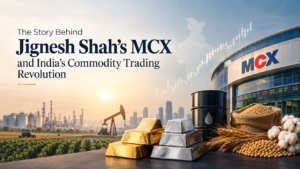
The Multi Commodity Exchange, or MCX, as it is popularly called, was the premier of 63 moons’ catalogue, as it was the world’s second-largest commodities exchange and #1 in gold and silver. It also went on to become the first publicly listed commodity exchange in the country and created over a million employment opportunities.
Another class leader in its segment was the Indian Energy Exchange (IEX), which completely changed the electricity trading in India, and as a result, it became a benchmark for the trading of electricity futures. IEX’s success was a testament to the foundations and technology of its parent company, 63 moons.
The MCX Stock Exchange (MCX-SX) was another significant initiative that went head to head with the powerhouses of the equity markets. Just two years after starting operations, it gained huge popularity for trading in currency derivatives, a clear indication of the entry of a major challenger in the Indian financial markets.
Shah’s dreams went far beyond just India. Through a few new initiatives, he spread his impact globally. One of these was the Dubai Gold and Commodities Exchange (DGCX), set up in collaboration with the UAE government, which grew to be a trading hub in the Middle East. The Singapore Mercantile Exchange (SMX) came out with a suite of commodity and currency products for pan-Asian markets. Other exchanges like Bourse Africa and Bahrain Financial Exchange also contributed to widening this network in different parts of the world.
India’s Early Make in India Financial Story
Jignesh Shah‘s work and philosophy were far ahead of the times, embodying the spirit of Make in India way before it became a buzzword. Jignesh Shah MCX created and democratised access to commodity markets.
IEX not only facilitated the availability of electricity but also played a role in balancing power markets. Along with such direct measures, entities like the National Bulk Handling Corporation provided a world-class warehousing capability for agricultural produce and provided formal credit systems to the rural parts of the country.
The same goes for technology, which was a key enabler of the change. Consider broking software like ODIN which, besides dominating 80% of the market in India, serves as the backbone for trading operations of thousands of brokers nationwide. As for Ticker, it furnished a live broadcast of the market happenings, thereby making sure that market players got their information without delay.
He was acknowledged worldwide for the change he brought to the markets and his dedication to the democratisation of equitable growth and access, a fact reiterated by the most noteworthy accolade that he was conferred with, the Young Global Leader recognition by the World Economic Forum, together with the Indian Express Innovation Award given to him by Dr A.P.J. Abdul Kalam.
A Legacy That Continues
Therefore, the legacy of Shah is more than the exchanges he created; it is also the example he set. Launching ten exchanges in just one decade was a feat that called not only for strong belief but also for far-sightedness. Moreover, the exchanges and ecosystems Shah built proved that Indian ingenuity was capable of not only following world standards but also setting them.
As Shah pioneered the IP lead, technology enabled financial ecosystems and exchanges, he presented one of the first and the most striking examples of the Make in India move at a large level. His efforts not only integrated the country more with global markets but also offered new livelihood opportunities to millions; thus, he has left a lasting mark on India’s present-day market structure as a financial powerhouse.