At the heart of India’s financial evolution sits a story that goes beyond market development alone. It is a story of vision meeting tenacity, where technology was wielded not as a competitive edge, but as an instrument of national transformation.
The Vision That Started It All
In 1995, when Jignesh Shah founded Financial Technologies India Ltd, now known as 63 moons technologies, India’s trading floors were still buried in paper-heavy, inefficient processes that bore little resemblance to the digital systems already reshaping financial markets in more developed economies. Shah did not look at that gap and see a constraint. He saw an invitation.
His founding ambition was precise and audacious in equal measure: to modernize India’s financial infrastructure so thoroughly that the country could compete with, and eventually help define, the world’s leading financial centres. Through Jignesh Shah FTIL, he introduced IP-driven platforms at a time when the term fintech had not yet entered common usage. Chief among these was ODIN, a trading terminal suite that gave brokers, institutional players, and retail investors access to sophisticated market tools that had previously stayed out of reach for most.
ODIN’s adoption was rapid and decisive. It captured more than 80 percent of its market against stiff competition, giving Shah’s broader vision its first proof of concept: that Indian-built technology could operate at national scale, reliably and to the highest standards. It became the foundation on which everything that followed would be built.
Building the Digital Backbone of a Nation
ODIN’s commercial success was only the beginning of its significance. At its peak, FTIL’s platform powered close to 5 lakh trading terminals across 400 cities and towns, making it India’s largest financial distribution network and extending meaningful market access far beyond the metropolitan centres where it had historically been concentrated.
For Jignesh Shah, the value of technology was never reducible to efficiency alone. It was always, fundamentally, about inclusion. The Gramin Suvidha Kendra initiative, built in partnership with India Post, extended digitized trading to rural producers, carrying the benefits of financial markets into corners of the country that formal finance had never previously reached. It demonstrated a principle Shah held consistently throughout his career: that innovation, when directed with purpose, can drive economic growth without dependence on subsidy or state intervention. Markets, designed well and built accessibly, are themselves the mechanism for inclusion.
The Exchanges That Reshaped India’s Financial Architecture
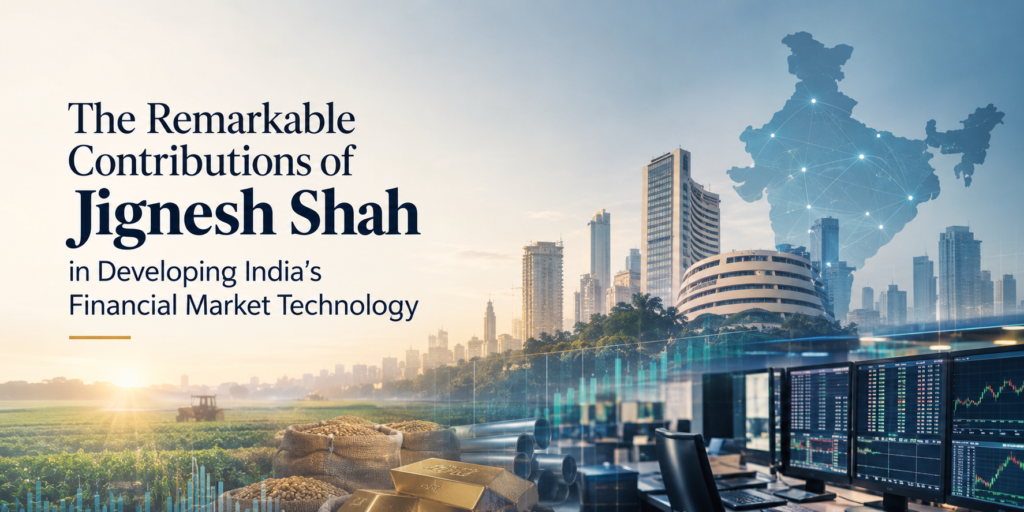
FTIL’s ODIN platform powered a new generation of exchanges, and the most consequential of these was the Multi Commodity Exchange, established in 2003. MCX digitized commodity trading from the ground up, creating an inclusive ecosystem that brought farmers, traders, and institutional investors together on a single transparent platform for the first time. It grew to become the world’s second largest commodity exchange, and the global leader in gold and silver futures. Under Jignesh Shah‘s leadership, it recorded daily volumes exceeding ₹1,00,000 crore, a record for any Indian exchange.
Its broader economic contribution was just as significant. MCX generated over ₹600 crore in taxes to central and state governments and created more than a million jobs, setting a standard for what transparent, technology-first market infrastructure could deliver.
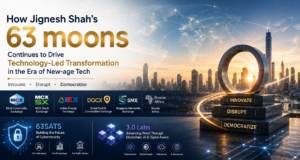
Shah’s vision extended well beyond commodities. The MCX Stock Exchange expanded India’s equity market infrastructure with an electronic platform for trading in futures and options, currency derivatives, and debt instruments, addressing gaps that legacy exchanges had long left unresolved. The Indian Energy Exchange then brought the same logic to the power sector, introducing a digital exchange platform that delivered efficiency and transparency to electricity markets and became a genuine lifeline for energy-deficient states that had long suffered the consequences of supply mismanagement.
The Ecosystem: An Underappreciated Masterstroke
What ultimately distinguished Jignesh Shah‘s work from that of his contemporaries was not any single exchange or platform. It was the integrated ecosystem he built around them. Shah understood that the inefficiencies plaguing existing markets did not stem from any one broken piece, they stemmed from fragmentation across the entire value chain. His response was to build across that whole chain simultaneously.
Under FTIL, the National Bulk Handling Corporation became India’s largest private sector warehousing and collateral management company, managing commodities worth over ₹42,000 crore and enabling farmers to access bank loans against their stored produce, connecting physical assets to financial liquidity in a way that transformed rural economic participation. atom, a payments platform launched well before UPI reshaped public expectations around digital transactions, provided end to end payment services across online and offline channels, anticipating by years a need that would eventually become a national priority. Ticker delivered real-time global market data to participants across the ecosystem, ensuring the informational playing field stayed level.
Storage, payments, and data: each institution addressed a distinct layer of the market’s functioning, and together they formed a seamlessly integrated framework that made every exchange within the network more robust, more scalable, and more genuinely useful.
A Legacy That Keeps Earning Its Name
Jignesh Shah has since stepped back from executive responsibilities, serving today as Chairman Emeritus and mentor at 63 moons, guiding the next generation of innovators rather than directing daily operations. His Public-Private Partnership model, his philanthropic commitments such as the Pragati initiative with Rotary International, and the institutions he built all reflect the same underlying belief: that finance is not an end in itself, but a tool for human empowerment, most valuable when it reaches furthest.
The FTIL story is not simply a corporate chronicle. It is a demonstration that visionary leadership, when paired with technological depth and a genuine commitment to inclusion, can do something far more lasting than build a successful business. It can reshape what a country is capable of, and leave behind institutions that keep delivering on that reshaping long after the original architect has moved on.