
The world of financial technology has changed dramatically over the last few decades, and few names capture that shift in India quite like Jignesh Shah. As the founder of Financial Technologies India Ltd. (FTIL), the company now known as 63 moons technologies limited, Shah set in motion a chain of ideas that reshaped how Indian markets traded, settled, and scaled. His early bets on technology did more than modernize exchanges. They set a template that other emerging economies would later study and try to replicate.
What made Shah’s thinking distinct was his refusal to accept the limits of conventional market infrastructure. At a time when “fintech” was not yet part of everyday vocabulary, he was already building platforms designed to make trading faster, cheaper, and more accessible to a wider base of participants. His Public-Private Partnership model, applied across multiple ventures, proved that ambitious financial infrastructure did not need to originate in the West to succeed globally. That single insight helped create a family of exchanges that changed how entire asset classes were traded.
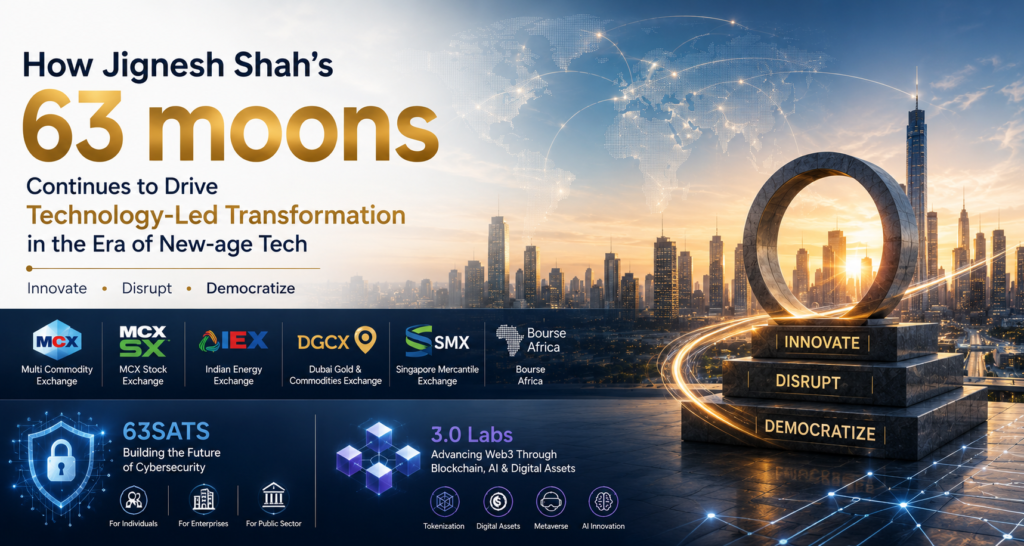
Today, Jignesh Shah is no longer involved in the day-to-day running of 63 moons. He holds the position of Chairman Emeritus, mentoring the next generation of the entrepreneurs of the organisation. Even from that distance, his imprint on the organization is unmistakable. The institutions born from his original thinking, including the Multi Commodity Exchange (MCX), MCX Stock Exchange (MCX-SX), Indian Energy Exchange (IEX), Dubai Gold and Commodities Exchange (DGCX), Singapore Mercantile Exchange (SMX), and Bourse Africa, continue to function as pillars of the financial ecosystem in their respective markets. Each of them still carries forward a shared philosophy: innovate first, disrupt what is outdated, and democratize access wherever possible.
A Guiding Philosophy That Shaped 63 moons
The phrase “innovate, disrupt, democratize” is more than a tagline for 63 moons. It functions as an operating principle that has guided the company since its founding in 1995, and it continues to inform the newer ventures under its umbrella, including 63SATS and 3.0 Labs. These initiatives are tackling problems in cybersecurity and decentralized technology with the same appetite for reinvention that once transformed Indian market infrastructure.
Building the Future of Cybersecurity Through 63SATS
Jignesh Shah has often framed the digital economy in a simple but memorable way: data functions like oil, artificial intelligence acts as the brain, and cybersecurity serves as the oxygen that keeps the whole system alive. That framing is the philosophical backbone of 63SATS, a cybersecurity initiative built on the technical foundation that 63 moons has spent decades developing. Where many competitors specialize narrowly, focusing only on audits or only on deployment, 63SATS positions itself as a full spectrum provider, serving businesses, individual users, and public sector clients from a single platform.
The strength of 63SATS lies in its flexibility. Instead of locking clients into a fixed framework, its offerings are shaped around the specific risks each client faces, which matters in an industry that changes month to month. That adaptability should serve 63SATS well in a cybersecurity market in India projected to reach roughly one lakh crore rupees by 2029. Its core products, CYBX, 63CSF, and CYBERDOME, protect individuals, enterprises, and critical national infrastructure respectively, addressing nearly every point on the cybersecurity spectrum rather than a single niche.
Advancing Web3 Through 3.0 Labs
As industries around the world experiment with decentralization, Jignesh Shah 63 moons has positioned 3.0 Labs as its vehicle for exploring blockchain, the metaverse, artificial intelligence, and digital assets. Through a series of partnerships, 3.0 Labs is expanding its footprint in tokenization and virtual digital asset services, areas still forming their rules globally. In many ways, this mirrors Shah’s earlier work in financial markets, entering a space before it is fully defined and helping shape what it becomes.
A Legacy That Continues to Expand
What makes Jignesh Shah’s legacy worth examining closely is not simply the list of institutions he built, but the consistency of the thinking behind them. Long before most entrepreneurs were talking about accessible markets or inclusive technology, Shah was designing systems around those exact ideas. The exchanges he founded were not just businesses; they were experiments in whether technology could make financial participation less exclusive. That experiment succeeded across multiple asset classes and multiple countries, which is part of why his influence continued to be felt well after he stepped back from operational responsibilities.
The transition to a mentorship role has not diminished that influence, it has redirected it. As Chairman Emeritus, Shah’s contribution now comes through guidance rather than direct control, shaping strategy and long-term thinking rather than daily decisions. The people currently running the company’s various ventures, from cybersecurity to Web3, are the ones translating that original philosophy into present day execution, while Shah focuses on coaching the broader direction.
This kind of legacy, one built on ideas that outlive a founder’s operational involvement, is rare. Many companies struggle to maintain a coherent identity once their founder steps back. 63 moons has done the opposite, using the transition as an opportunity to expand into new domains while still anchoring every venture in its founding principles. That continuity, more than any single product or exchange, may be the most lasting contribution of all.
As blockchain, artificial intelligence, and decentralized systems continue to reshape global industries, 63 moons remains active in that conversation, building on ideas that trace back to Shah’s earliest work in financial markets. His mentorship continues to shape a new generation of builders inside the organization, offering proof that the impact of a good idea does not have to end when its originator steps away from the boardroom. For an industry that often celebrates disruption for its own sake, Jignesh Shah’s legacy is a reminder that lasting impact usually comes from ideas built to outlast their creator.